The trade runs on refrigerant certification, supervised field hours and seasonal call-outs — here is what the work involves and how people get in.
You become an HVAC technician by completing a 6-month to 2-year HVACR program at a technical school or community college, or by entering a registered apprenticeship, then passing the EPA Section 608 refrigerant exam and getting hired by a contractor. The U.S. Bureau of Labor Statistics (2025) lists postsecondary instruction in HVACR as the typical entry route, and notes that nearly all technicians must be certified in proper refrigerant handling.
Most people reach a first paid role within a few months to two years, depending on whether they study first or earn while they learn. The work is physical, seasonal and often on call.
What an HVAC Technician does
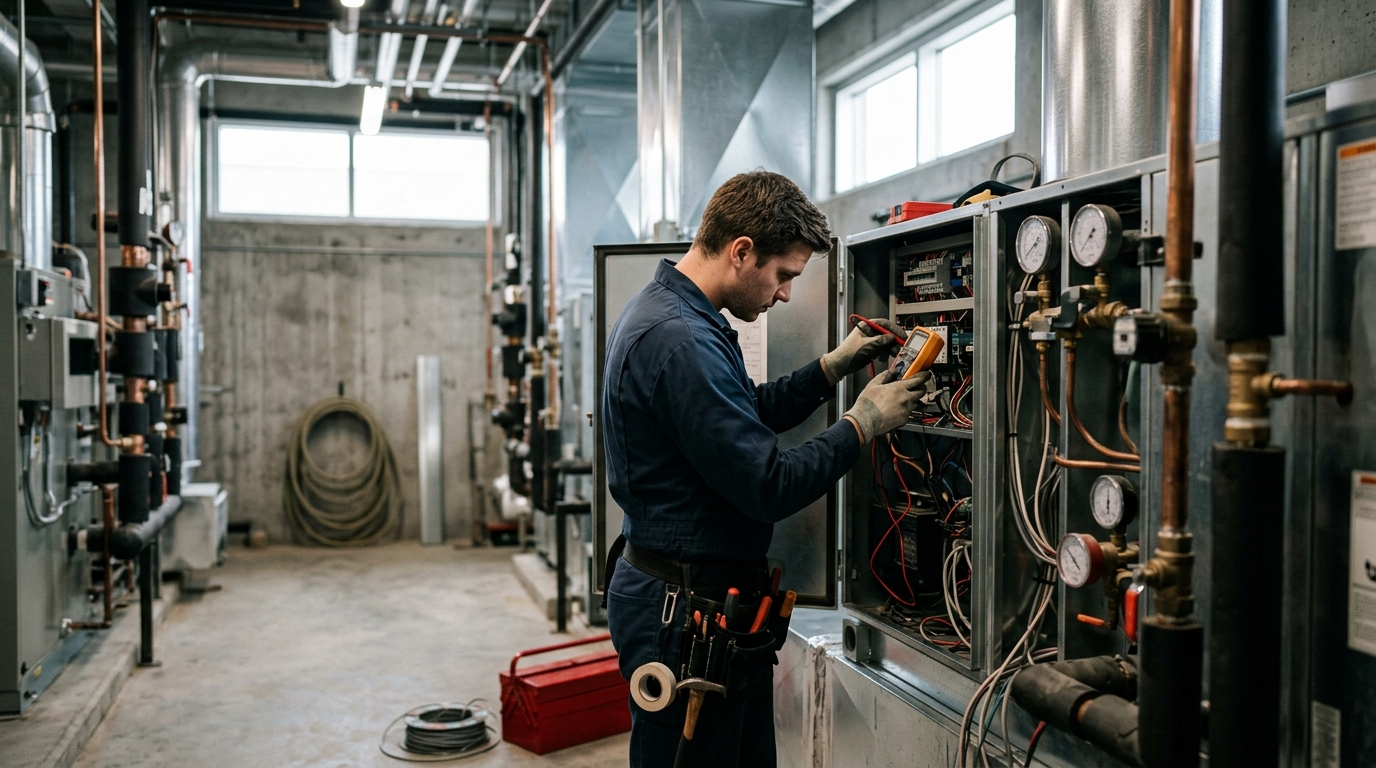
HVAC technicians install, maintain and repair heating, ventilation, air conditioning and refrigeration (HVACR) systems. A typical day mixes scheduled maintenance with breakdown calls.
- Install HVACR equipment and connect electrical components and wiring, following the manufacturer's instructions and local code (U.S. Bureau of Labor Statistics, 2026-08-27).
- Inspect and test systems — check refrigerant charge, static pressure, amp draw and temperature split to find out what is actually wrong.
- Repair or replace worn parts such as capacitors, contactors, blower motors, igniters and compressors.
- Recover, evacuate and recharge refrigerant, then leak-test the system before returning it to service.
- Explain the malfunction to the customer, including what the repair costs and what happens if they wait.
- Recommend maintenance — filter changes, coil cleaning, drain treatment — and sell or schedule a service plan.
- Keep records of work performed: invoices, readings, part numbers and warranty paperwork, usually on a phone or tablet.
Where you work. The largest employer of these workers is plumbing, heating and air-conditioning contractors (U.S. Bureau of Labor Statistics, 2025). Others work for schools, hospitals, supermarkets, manufacturers and building-maintenance departments. Reported job titles include A/C Tech, HVAC Installer, HVAC Mechanic, HVAC Service Tech, Refrigeration Technician and Service Technician (O*NET OnLine, U.S. Department of Labor).
Schedule, and the honest downside. Most technicians work full time, with schedules that may include evening or weekend shifts; they may be on call for emergencies and sometimes work overtime or irregular hours during peak heating and cooling seasons (U.S. Bureau of Labor Statistics, 2025). That means attics in July, roofs in January, crawl spaces, ladders and heavy equipment. Summer and deep winter are relentless; the shoulder seasons can be slow enough that hours drop. If you dislike being dirty, hot or interrupted at 9pm, this is not the trade for you.
Skills you'll need
Hard skills
- Refrigeration cycle diagnosis. Read superheat and subcooling off a manifold gauge set or digital probes and decide whether the problem is charge, airflow or a failing metering device. This is the skill that separates a parts-changer from a technician.
- Electrical troubleshooting. Use a multimeter and clamp meter to check voltage, continuity, capacitance and amp draw, and read a ladder diagram to trace a control circuit back to the failed component.
- Evacuation and brazing. Pull a system to a target vacuum with a pump and micron gauge, braze line sets under flowing nitrogen, and pressure-test for leaks. Sloppy work here causes callbacks weeks later.
- Airflow and combustion measurement. Use a manometer to check static pressure and gas pressure, and a combustion analyzer on furnaces and boilers. Carbon monoxide work has no margin for guessing.
- Math and blueprint reading. Load calculations, duct sizing and conversions are daily arithmetic; math skills and being detail oriented are listed among the important qualities for the occupation (U.S. Bureau of Labor Statistics, 2025).
- Software and documentation. Service apps, manufacturer diagnostic tools and, on the design and commercial side, CAD — Autodesk AutoCAD is listed among the technologies used in this occupation (O*NET OnLine, U.S. Department of Labor).
Soft skills, and how to show them
- Customer service. Listed among the occupation's important qualities (U.S. Bureau of Labor Statistics, 2025). Show it by explaining a repair without jargon and giving the customer a clear choice: fix now, fix later, replace. In an interview, describe a time you told someone bad news and they still trusted you.
- Problem-solving. Show it by walking an interviewer through one fault you diagnosed step by step, including the wrong guess you ruled out.
- Physical stamina and strength. Also listed among the important qualities (U.S. Bureau of Labor Statistics, 2025). Show it with any job history involving lifting, ladders or outdoor work in heat.
- Reliability. Turning up at 7am every day in February is most of it. Show it with references from a previous supervisor who can say you were never a no-show.
- Teaching and patience. Senior techs who can train helpers get promoted. Show it by offering to run a toolbox talk or document a tricky repair for the shop.
Pay and outlook
The U.S. Bureau of Labor Statistics publishes a 2025 median pay figure for heating, air conditioning and refrigeration mechanics and installers, along with a projected job outlook for 2025-35, in the Occupational Outlook Handbook — check that page for the current numbers rather than relying on job-board averages, which skew high because they advertise top-of-band and commission-inclusive figures.
What moves your pay within the trade: the type of work (commercial refrigeration and controls work generally pays above residential changeouts), your certifications, whether you can run calls solo, your state's licensing regime, union versus non-union shops, and your metro area. Overtime and on-call pay are a large part of total earnings for many technicians, because schedules may include evenings and weekends and overtime is common during peak heating and cooling seasons (U.S. Bureau of Labor Statistics, 2025). Many service shops also pay a commission or spiff on equipment and maintenance-plan sales, which is why two technicians at the same shop can earn very differently.
On demand: BLS projects about 40,600 openings for these workers each year on average over the 2025-35 decade, with most arising from the need to replace workers who move to other occupations or leave the labour force (U.S. Bureau of Labor Statistics, 2025). Equipment has to be replaced and maintained wherever buildings exist, which keeps the work geographically spread and difficult to offshore.
The honest caveat: earnings are seasonal and hours fluctuate. A flat-rate pay structure rewards speed, and some shops lean hard on sales targets. Ask at interview how pay is structured — hourly, flat rate, or hourly plus commission — and what happens to your hours in April and October.
For state-by-state pay differences and licensing requirements, use the BLS Occupational Outlook Handbook and CareerOneStop, which BLS names as the source for state licensing board requirements (U.S. Bureau of Labor Statistics, 2025).
Career path
The occupation is classified as Job Zone Three, Medium Preparation Needed: employees usually need one or two years of training involving both on-the-job experience and informal training with experienced workers, and a recognized apprenticeship program may be associated with the occupation (O*NET OnLine, U.S. Department of Labor). Progress is measured in supervised hours and the calls you can close alone.
| Stage | Typical titles | Typical years | What changes |
|---|
| Entry | Helper, Apprentice, HVAC Installer | 0-2 years | You carry equipment, run line sets, pull vacuums and assist. You hold EPA 608 and work under a certified technician. |
| Developing | HVAC Service Tech, A/C Tech, Maintenance Tech | 2-5 years | You run your own van and your own maintenance calls, diagnose common faults, and quote repairs. NATE certification often lands here. |
| Senior | Lead Technician, Refrigeration Technician, Commercial Service Tech, Controls Tech | 5-10 years | You take the calls nobody else solved, work on rack refrigeration, chillers, boilers or building controls, and train apprentices. |
| Beyond the van | Service Manager, Field Supervisor, Estimator, Sales Engineer, Instructor, Licensed Contractor | 10+ years | You run schedules, price jobs, teach, or hold the contractor's licence and run the business. |
Two common side-steps: into institutional facilities work (hospitals, universities, data centres) for steadier hours and no on-call van, or into manufacturer technical support and training. Both usually require the field years first.
Specialising pays. Commercial refrigeration, building automation controls, hydronics and high-efficiency heat pump systems are the areas where experienced technicians are hardest to replace.
Frequently asked questions
Do I need a degree to become an HVAC technician?
No four-year degree is required. The U.S. Bureau of Labor Statistics (2025) identifies postsecondary instruction from a technical or trade school or community college as the typical entry-level education, with HVACR programs generally lasting from 6 months to 2 years and leading to a certificate or an associate's degree. Some technicians instead train through an apprenticeship, which usually lasts several years and combines paid on-the-job training with technical instruction each year. What you cannot skip is EPA Section 608 certification for refrigerant handling, and state or local licensing where your area requires it — check CareerOneStop for your state's board requirements.
How long does it take to get my first HVAC job?
It depends on the route. If you join a registered apprenticeship or start as an installer's helper, you can be earning within weeks, though full apprenticeship completion takes several years — Wisconsin's registered HVAC Installer-Technician apprenticeship, for example, takes about 5 years with 7,824 on-the-job hours and 576 hours of paid classroom instruction (Wisconsin Department of Workforce Development). If you study first, a certificate program of 6 months to 2 years (U.S. Bureau of Labor Statistics, 2025) comes before your first full-time role. Hiring is seasonal, so applying in late spring or early autumn usually shortens the wait.
Can HVAC work be done remotely?
The technician job cannot. Installing, testing and repairing equipment requires you to be in the building, on the roof or in the crawl space. The adjacent roles that can be partly remote come later in a career: building automation and controls monitoring, estimating, manufacturer technical support, dispatch and service management, and design work using CAD software such as Autodesk AutoCAD, which O*NET lists among the technologies used in this occupation. All of those typically expect field experience first.
What is EPA 608 certification and how much does it cost?
Section 608 of the Clean Air Act requires anyone who maintains, services, repairs or disposes of appliances containing ozone-depleting refrigerants to be certified in proper refrigerant handling, with four certification types: Core, Type I, Type II, Type III and Universal, which covers all four sections (Refrigeration Service Engineers Society). Costs range from $100 to $500 depending on the provider, course format and package contents; the test alone costs between $30 and $50 per attempt, with online proctoring adding about $25 (The Training Center). Apprentices are exempt while closely and continually supervised by a certified technician (Refrigeration Service Engineers Society). The exam is often included as part of completing a postsecondary HVACR program (U.S. Bureau of Labor Statistics, 2025).
Is NATE certification worth getting?
It is optional but widely recognised by employers and manufacturers. NATE certifies technicians through a core exam plus at least one specialty exam, or through the five-exam Certified HVAC Professional (CHP-5) pathway covering HVAC fundamentals, electrical and controls, comfort and airflow, installation and service; certification must be renewed every two years, either by completing 16 continuing education hours or by retaking the specialty exam (Carrier). Most technicians sit it after a year or two in the field, when the questions match work they have actually done. Ask your employer whether they reimburse the fee — many do.