Most of the clock goes to one accredited two-year degree; the rest is prerequisites, a national exam and whatever paperwork your state board asks for.
For most people it takes about two to three years to become a physical therapist assistant. The core requirement is an associate's degree from an accredited program, which the American Physical Therapy Association describes as typically two years, or five semesters, with roughly 75% classroom and lab study and 25% clinical education (American Physical Therapy Association, undated). Add a few months on either end for prerequisite courses and for licensing paperwork after you graduate.
The U.S. Bureau of Labor Statistics states that all states require physical therapist assistants to hold an associate's degree from an accredited program and to be licensed or certified (U.S. Bureau of Labor Statistics, 2026-08-27). What varies is the application calendar at the program you choose, how many prerequisites you already have, and how quickly your state board processes a licence after exam results come through.
What a physical therapist assistant does
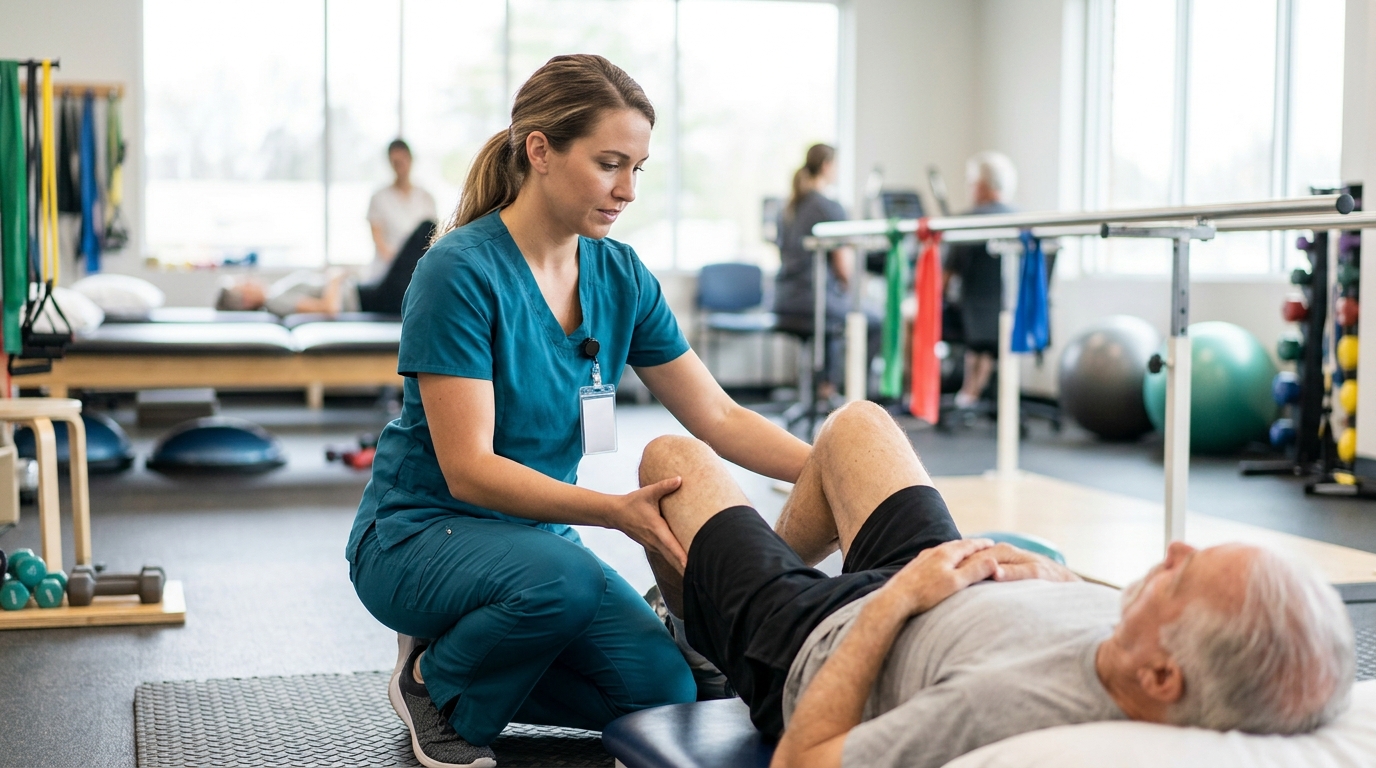
You work under the direction of a physical therapist, carrying out the plan of care that therapist has written. You are not diagnosing or setting goals; you are delivering treatment, watching what happens and reporting back.
A typical day includes:
- Helping patients through specific exercises that form part of the plan of care, and instructing, motivating and safeguarding them while they practise functional activities (U.S. Bureau of Labor Statistics, 2026-08-27; O*NET OnLine, undated).
- Treating patients with hands-on techniques such as massage and stretching (U.S. Bureau of Labor Statistics, 2026-08-27).
- Observing patients before, during and after therapy, then reporting status and results to the supervising physical therapist (U.S. Bureau of Labor Statistics, 2026-08-27; O*NET OnLine, undated).
- Setting up and using devices and equipment such as walkers, and securing patients into or onto therapy equipment (U.S. Bureau of Labor Statistics, 2026-08-27; O*NET OnLine, undated).
- Teaching body mechanics and functional mobility, including things like aquatic exercise where the clinic offers it (O*NET OnLine, undated).
- Educating patients and family members about care after treatment ends — what to do at home, what to avoid (U.S. Bureau of Labor Statistics, 2026-08-27).
- Documenting progress in the clinic's record system, usually at the end of each visit or squeezed between them (O*NET OnLine, undated).
Where the work is. Physical therapist assistants held about 114,100 jobs in 2025, with the largest employers being offices of physical, occupational and speech therapists and audiologists (44%), hospitals (20%), home healthcare services (12%), nursing care facilities (10%) and offices of physicians (6%) (U.S. Bureau of Labor Statistics, 2026-08-27). The APTA puts roughly 72% of PTAs in hospitals or privately owned outpatient practices, with others in home health, schools and skilled nursing or long-term care (American Physical Therapy Association, undated). The day looks different in each: outpatient orthopaedics runs on a tight appointment grid, home health means driving between houses, and a skilled nursing facility means heavier assist levels and more documentation tied to billing.
Schedule. Most PTAs and aides work full time, though part-time work is common, and some work nights and weekends because many clinics keep extended hours (U.S. Bureau of Labor Statistics, 2026-08-27). Evening slots are often the busiest in outpatient clinics, because that is when working patients can come.
The honest downside. This is physical work. PTAs and aides are frequently on their feet setting up equipment and helping care for patients (U.S. Bureau of Labor Statistics, 2026-08-27). You will transfer people who cannot bear their own weight, kneel on hard floors and repeat the same manual techniques all day. Productivity expectations in some settings leave documentation to the end of the shift. And because you work under a therapist's plan, you may disagree with it and still have to follow it — your route is to raise it with the supervising PT, not to change the plan yourself.
How to become one
- Confirm the accreditation requirement before you pay anyone anything. To work as a PTA in the U.S. you must graduate from a program accredited by the Commission on Accreditation in Physical Therapy Education (CAPTE) and pass a state-administered national exam for the licence or certification required in most states (American Physical Therapy Association, undated). Check a program's CAPTE accreditation status directly, not from the school's brochure. Time: an afternoon. Cost: none.
- Call the admissions adviser at two or three accredited programs and ask for the prerequisite list in writing. Entry-level PTA education is offered at the associate degree level and applicants apply directly to the program, rather than being admitted to the college and selecting a major later (American Physical Therapy Association, undated). Ask about the application deadline, the cohort start date, whether observation hours are required and how many applicants they take. Time: 2–6 weeks of calls and campus visits. Cost: usually none beyond travel.
- Finish the prerequisite coursework you are missing. This commonly means general anatomy and physiology, English and maths at the level the program specifies. Time: one or two semesters if you are starting from scratch, none if your transcript already covers it. Cost: priced per credit hour and varies enormously between in-district community college rates and private college rates — ask the registrar for the current per-credit figure and the full cost of attendance.
- Submit the program application with transcripts, observation hours and any required health records. Programs often want documented hours shadowing a PT or PTA, immunisation records and sometimes a background check before clinicals. Time: 4–8 weeks to assemble; decisions can take a further 1–3 months. Cost: an application fee set by the school, plus transcript and background-check fees — ask what the current total is.
- Complete the accredited associate degree. The average PTA program is typically two years, or five semesters, covering anatomy, physiology, exercise physiology, biomechanics, kinesiology, neuroscience, clinical pathology, behavioural sciences, communication and ethics; about 75% is classroom and lab and 25% is clinical education, with students spending on average 16 weeks in full-time clinical experiences (American Physical Therapy Association, undated). Treat those clinical placements as a long interview — many PTAs are hired by a site they trained at. Time: about 2 years. Cost: tuition plus books, scrubs and travel to clinical sites.
- Get current CPR and basic life support certification. PTAs may earn certifications in CPR, basic life support (BLS) or other first-aid skills, and certification information is available from CareerOneStop (U.S. Bureau of Labor Statistics, 2026-08-27). Most programs require this before your first placement. Time: a half or full day for a BLS course. Cost: a modest course fee that varies by provider.
- Apply to your state board for licensure and sit the qualifying exam. All states require PTAs to be licensed or certified; licensure typically requires graduation from an accredited program and passing a qualifying exam, and some states also require an exam on state physical therapy practice laws, a criminal background check and a minimum age of 18 (U.S. Bureau of Labor Statistics, 2026-08-27). Requirements and fees differ by state, so work from your own board's checklist. Time: application processing plus exam scheduling, often 1–3 months end to end. Cost: exam fee, state application fee and fingerprinting fee — all set by the state.
- Apply for your first role and learn the clinic's documentation system fast. Medical software used in the job includes EHR systems such as eClinicalWorks and TherAssist, alongside scheduling software and office suites such as Microsoft Office (O*NET OnLine, undated). In interviews, be specific about caseloads you handled on placement: diagnoses, assist levels, equipment. Time: typically a few weeks to a few months, depending on your area and how willing you are to take evenings, weekends or PRN shifts. Cost: none beyond licence upkeep.
After you are working, continuing education keeps the licence active — the rules and hour counts are set by your state board. The APTA also runs a voluntary PTA Advanced Proficiency Pathways program covering content areas including acute care, cardiovascular/pulmonary, geriatrics, neurology, oncology, orthopaedics, paediatrics and wound management (American Physical Therapy Association, undated).
Pay and outlook
The median annual wage for physical therapist assistants was $68,380 in May 2025, with the lowest 10 percent earning less than $47,750 and the highest 10 percent more than $89,510 (U.S. Bureau of Labor Statistics, 2026-08-27). That spread is the useful part of the figure — it tells you the same credential pays very differently depending on where and how you work.
What moves you within that range:
- Setting. Outpatient therapy offices, hospitals, home healthcare, nursing facilities and physicians' offices are the five largest employers, and they do not pay alike (U.S. Bureau of Labor Statistics, 2026-08-27). Home health and skilled nursing often pay more per visit or per hour and ask more of you in travel, documentation or acuity.
- Geography. Pay and licensing both vary by state, and within a state by metro area. A clinic in a high-cost city and one in a rural county will post very different numbers for the same job description.
- Schedule. Because many clinics keep extended hours and some PTAs work nights and weekends (U.S. Bureau of Labor Statistics, 2026-08-27), shift differentials, PRN rates and weekend premiums are common ways to raise earnings without changing jobs.
- Experience and scope. Years in a specialty, clinical instructor duties and voluntary credentials such as the APTA's PTA Advanced Proficiency Pathways (American Physical Therapy Association, undated) give you something concrete to negotiate on.
- Pay structure. Most PTA roles are hourly or salaried with benefits; home health is frequently paid per visit, which rewards efficiency and penalises a light week.
On demand: employment of physical therapist assistants is projected to grow 23 percent from 2025 to 2035, while the combined physical therapist assistants and aides occupation is projected to grow 17 percent, much faster than average, with about 24,900 openings projected each year for the combined occupation (U.S. Bureau of Labor Statistics, 2026-08-27). The BLS attributes rising demand to the health needs of an aging population, and notes that providers in outpatient and long-term care settings are expected to rely on PTAs to reduce the cost of physical therapy services (U.S. Bureau of Labor Statistics, 2026-08-27).
For current pay and projections, check the Occupational Outlook Handbook page for physical therapist assistants and aides at the U.S. Bureau of Labor Statistics, and look at the state and metropolitan wage tables there rather than the national median alone. For licensing fees and renewal rules, go to your own state's physical therapy board.
Career path
| Stage | Typical titles | Usual time at this stage |
|---|
| Student and clinical | PTA student, student on clinical affiliation | About 2 years, including roughly 16 weeks of full-time clinical education (American Physical Therapy Association, undated) |
| Entry | Licensed physical therapist assistant, staff PTA, PRN PTA | 0–2 years |
| Mid | PTA with a settled specialty — orthopaedics, geriatrics, neurology, acute care, home health; clinical instructor for students | 2–5 years |
| Senior | Lead PTA, senior PTA, rehab site or program coordinator, scheduler or clinic operations lead | 5–10+ years |
Entry. Your first year is about speed and safety: building a caseload, learning the EHR, and getting comfortable reporting to the supervising PT when something changes. Many new PTAs take evening, weekend or PRN shifts to get in the door, and the clinical site where you trained is often the most realistic first employer.
Mid. Between roughly two and five years you usually settle into a population. This is where the APTA's voluntary PTA Advanced Proficiency Pathways program fits — it covers content areas including acute care, cardiovascular/pulmonary, geriatrics, neurology, oncology, orthopaedics, paediatrics and wound management (American Physical Therapy Association, undated). Taking students as a clinical instructor is the other common mid-career step, and it is how most people move toward a lead role.
Senior. Senior PTA roles are usually part clinical and part coordination: mentoring new hires, managing the schedule grid, handling equipment and supplies, or running a site's rehab program under a PT director. Some PTAs move sideways into home health, school-based therapy or long-term care for the autonomy and the pay structure. Others move out of direct care entirely into clinic operations, device or equipment sales, or program administration.
A note on becoming a physical therapist. Becoming the therapist rather than the assistant means a separate, longer university program at the doctoral level — the PTA degree is not a partial credit toward it in any automatic way. If that is the goal, ask CAPTE-accredited physical therapist programs directly which of your credits transfer and what prerequisites they still require, before you plan around it.
Frequently asked questions
Do I need a degree to become a physical therapist assistant?
Yes. The U.S. Bureau of Labor Statistics states that all states require physical therapist assistants to have an associate's degree from an accredited program, typically lasting about two years and including anatomy, physiology and kinesiology plus supervised clinical work (U.S. Bureau of Labor Statistics, 2026-08-27). The APTA adds that the program must be accredited by the Commission on Accreditation in Physical Therapy Education, or CAPTE (American Physical Therapy Association, undated). Survey data on the occupation shows 84% of respondents said a new hire needs an associate's or other two-year degree, with 15% saying a bachelor's degree is required (O*NET OnLine, undated) — but the two-year accredited degree is the standard route.
How long does it take in total, including everything?
Plan on two to three years. The program itself averages two years, or five semesters (American Physical Therapy Association, undated). Add one or two semesters if you still need prerequisite courses, and add one to three months after graduation for the state licence application, background check and exam scheduling. The spread comes from three things: how many prerequisites you already hold, whether your chosen program admits once a year or twice, and how fast your state board processes applications.
Can a physical therapist assistant work remotely?
Not in any meaningful way. The job is hands-on: treating patients with techniques such as massage and stretching, setting up equipment, and securing patients onto therapy equipment (U.S. Bureau of Labor Statistics, 2026-08-27; O*NET OnLine, undated). PTAs and aides are frequently on their feet throughout the day (U.S. Bureau of Labor Statistics, 2026-08-27). Some charting can be finished off-site depending on employer policy and the EHR, and home health shifts the work to patients' houses rather than a clinic — but there is no desk-based version of this role.
Can I study part time or finish faster?
That depends entirely on the program. Accredited PTA programs run as a cohort with a fixed sequence of lab courses and clinical placements, so there is rarely a way to compress the clinical portion — students spend on average 16 weeks in full-time clinical education (American Physical Therapy Association, undated). Some colleges offer evening or extended-track options that spread the coursework over more semesters, which makes it longer rather than shorter. Ask the admissions adviser whether a part-time track exists and how the clinical weeks are scheduled, because full-time placements are difficult to combine with another job.
Does my licence transfer if I move to another state?
Not automatically. All states require PTAs to be licensed or certified, and some additionally require an exam on that state's physical therapy practice laws, a criminal background check and a minimum age of 18 (U.S. Bureau of Labor Statistics, 2026-08-27). Requirements, fees and renewal cycles are set state by state, so contact the physical therapy board in the state you are moving to and work from their checklist before you accept a job there.